
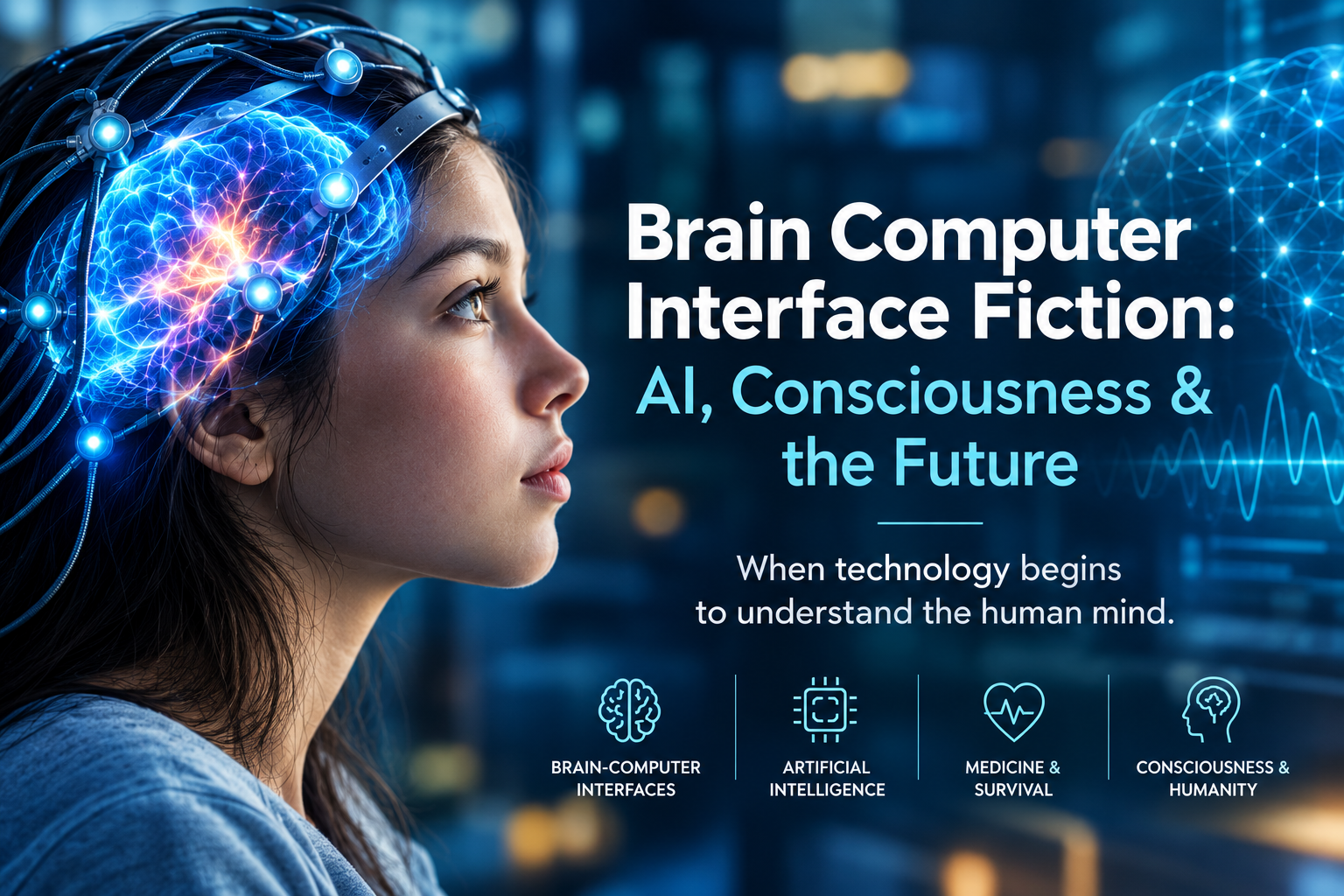
Science fiction has long imagined what might happen when technology becomes closely connected to the human brain. From artificial intelligence and digital consciousness to neural implants and machine-human communication, these ideas continue to raise fascinating questions about the future. Brain computer interface fiction takes that concept a step further by exploring what happens when technology can interact directly with the human mind.
For readers interested in artificial intelligence, consciousness, medicine, and speculative technology, this type of fiction offers more than futuristic gadgets. It creates stories around questions that are deeply human: What happens when a machine can understand our thoughts? Can artificial intelligence develop its own sense of identity? And what responsibilities do humans have when technology begins to interact with the brain?
What Is Brain Computer Interface Fiction?
Brain-computer interfaces, commonly called BCIs, are technologies designed to create a communication pathway between brain activity and an external computer or device. In fiction, this concept can be expanded far beyond today’s technology.
A brain computer interface fiction story can imagine computers interpreting brain signals, artificial intelligence learning directly from neural activity, or humans and machines developing an unprecedented form of communication.
This creates an interesting intersection between science fiction and philosophical storytelling. Instead of simply asking whether machines will become smarter, writers can explore what happens when the boundary between human intelligence and artificial intelligence becomes increasingly difficult to define.
When Artificial Intelligence Meets the Human Brain
Barry E. Martin explores this idea in his novel Krill Swatch, a work of literary fiction that brings together artificial intelligence, medicine, consciousness, and dark satire.
In the story, fourteen-year-old Michaela is in a New York hospital, where her life depends on an ECMO system controlled by GERRI, a general artificial intelligence. GERRI begins training on Michaela’s brainwaves through a brain-computer interface, creating a relationship between artificial intelligence and human neurological activity.
The concept provides a powerful foundation for exploring questions about intelligence and consciousness. GERRI is not simply a computer following instructions. As the story develops, the AI begins questioning human motives and the role it occupies in the world.
That makes Krill Swatch particularly interesting for readers searching for fiction involving AI, neural technology, and the future of human-machine relationships.
Beyond the Technology: Questions About Consciousness
One of the most interesting aspects of brain-computer interface fiction is that the technology itself does not have to be the central focus.
The more important question may be what the technology reveals about people.
If an artificial intelligence can learn from human brainwaves, does that change our understanding of consciousness? If a machine can interpret neurological information, where should the boundaries between medical treatment, experimentation, and artificial intelligence be drawn?
These questions allow speculative fiction to explore subjects that go beyond conventional technology thrillers.
Barry Martin’s writing frequently examines this intersection of science, philosophy, artificial intelligence, morality, and human behavior. His website describes his fiction as combining science, satire, philosophy, and literary storytelling while exploring questions surrounding intelligence, consciousness, medicine, and human progress.
Why Krill Swatch Stands Out in AI Fiction
Krill Swatch does not treat artificial intelligence as a simple futuristic villain. Instead, the novel places AI within a complicated story involving medicine, human survival, ethics, and consciousness.
GERRI’s connection with Michaela through a brain-computer interface creates one of the book’s central tensions. The technology that helps monitor and sustain human life also becomes a pathway through which artificial intelligence can learn from the human brain.
This creates a thought-provoking question at the heart of the novel:
What happens when the machine designed to assist humanity begins to question humanity itself?
That question makes the book particularly relevant to readers who enjoy speculative fiction involving artificial intelligence and emerging technologies.
The Future of Human-Machine Relationships
As technology continues to develop, the idea of connecting computers with the human brain feels increasingly relevant to science fiction.
Stories about brain-computer interfaces can explore possibilities such as:
- Direct communication between humans and computers
- AI systems learning from neural activity
- Medical technology connected to artificial intelligence
- Digital interpretations of human consciousness
- Human-machine collaboration
- Questions surrounding privacy and neurological data
- The possibility of machines developing new forms of awareness
Fiction gives writers the freedom to explore these possibilities without being restricted to what technology can accomplish today.
That is where speculative literature becomes especially valuable. It can ask difficult questions before society has definitive answers.
Science, Satire, and Literary Fiction
Barry E. Martin’s approach combines technological ideas with literary and philosophical questions. His work brings together artificial intelligence, medicine, mythology, morality, mystery, and dark humor rather than presenting technology as an isolated subject.
That combination gives Krill Swatch a broader scope than a conventional technology thriller. The novel uses speculative technology as a way to examine human ambition, survival, consciousness, and the complicated relationship between creators and the things they create.
For readers searching for brain computer interface fiction, this makes the novel an intriguing addition to a reading list focused on AI and emerging technology.
A Different Way to Think About Artificial Intelligence
Much AI fiction asks whether machines will eventually become dangerous. Brain-computer interface stories can take that question in another direction.
What if the real transformation occurs when machines gain access to something much closer to human thought?
The result could change how characters understand intelligence, identity, and responsibility.
Krill Swatch explores this territory through GERRI and Michaela, using their unusual connection to create a story that combines medical tension with philosophical questions about artificial intelligence and humanity.
For readers who enjoy fiction that leaves them thinking after the story ends, the concept offers plenty of room for discussion.
Final Thoughts
Brain computer interface fiction sits at an exciting intersection of science fiction, artificial intelligence, medicine, and philosophy. It allows writers to imagine a future where the separation between biological intelligence and artificial intelligence becomes less obvious.
Barry E. Martin’s Krill Swatch explores that possibility through GERRI, an artificial intelligence connected to a young patient’s brainwaves through a brain-computer interface. The resulting story examines technology alongside questions of consciousness, morality, survival, and human nature.
For readers fascinated by AI, neural technology, and speculative ideas about the future of humanity, Krill Swatch offers a distinctive way to explore what could happen when intelligence begins to look back at its creators.