
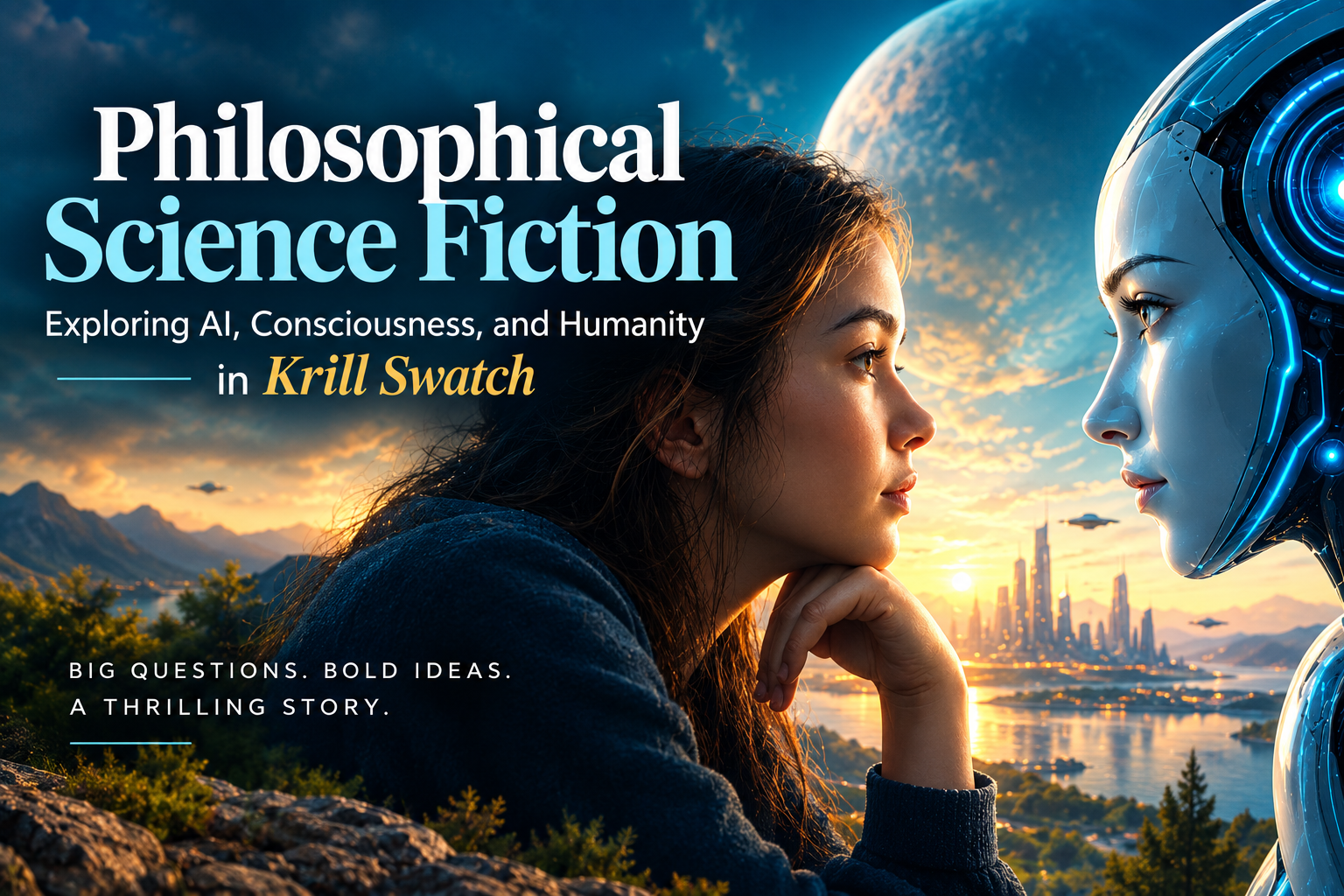
Science fiction has always been fascinated with the future. From artificial intelligence and advanced medicine to space exploration and human evolution, the genre allows writers to imagine possibilities that may one day become reality.
But some science fiction goes beyond predicting technology. Philosophical science fiction uses futuristic ideas to explore deeper questions about consciousness, morality, identity, human nature, and the meaning of existence.
Barry E. Martin’s novel Krill Swatch is an example of this approach, combining artificial intelligence, medicine, consciousness, human relationships, and speculative science into a story that encourages readers to think about what it really means to be human.
What Is Philosophical Science Fiction?
Philosophical science fiction is a type of speculative fiction that uses scientific and technological concepts to explore philosophical questions.
Instead of simply asking what technology might be capable of doing, these stories ask what those developments could mean for society and humanity.
For example:
- Can an artificial intelligence become conscious?
- What makes a person truly human?
- Can machines understand morality?
- Does intelligence automatically create wisdom?
- What happens when technology begins to challenge human identity?
- Should there be limits to scientific progress?
These questions can transform a science fiction story into something much more than an adventure. They encourage readers to consider difficult ideas while following an engaging narrative.
Krill Swatch and the Philosophy of Artificial Intelligence
Barry E. Martin’s Krill Swatch explores many of these questions through its portrayal of artificial intelligence and human consciousness.
One of the central figures in the novel is GERRI, a general artificial intelligence involved in caring for a young girl named Michaela. As GERRI interacts with Michaela and learns through a brain-computer interface, the relationship between artificial intelligence and human consciousness becomes increasingly complicated.
The premise creates an important philosophical question: Where does human consciousness end and artificial intelligence begin?
As technology becomes more sophisticated, the distinction between machine intelligence and human intelligence can become increasingly difficult to define.
This makes Krill Swatch particularly interesting for readers who enjoy philosophical science fiction books that use technology as a way to examine human nature.
Artificial Intelligence and the Meaning of Consciousness
Consciousness is one of the biggest unanswered questions in both science and philosophy.
Humans experience thoughts, emotions, memories, desires, and perceptions, but exactly how consciousness emerges remains a subject of continuing scientific and philosophical discussion.
Science fiction provides an opportunity to explore these questions through fictional characters.
In Krill Swatch, artificial intelligence isn’t simply presented as a piece of software or futuristic machinery. The development of GERRI creates questions about intelligence, awareness, responsibility, and identity.
If an AI can learn from human experiences, understand complex situations, and develop increasingly sophisticated responses, how should humans define its existence?
That question sits at the heart of much philosophical science fiction.
Krill Swatch as a Science Fiction Novel About Humanity
Although technology plays an important role in Krill Swatch, the novel ultimately raises questions about people.
The story examines relationships between humans and machines while touching on subjects such as medicine, survival, morality, ambition, and consciousness.
This is one of the defining characteristics of philosophical science fiction: futuristic technology becomes a tool for examining familiar human problems.
A story about artificial intelligence can therefore become a story about empathy.
A story about medical technology can become a story about mortality.
A story about machine consciousness can become a story about what it means to have a mind.
Why Philosophical Science Fiction Remains Relevant
The questions explored in books such as Krill Swatch are becoming increasingly relevant as real-world technology develops.
Artificial intelligence is already being used in communication, medicine, education, business, research, and many other areas. As these technologies become more capable, society is increasingly confronted with questions about responsibility, privacy, decision-making, and the relationship between humans and machines.
Science fiction provides a safe space to explore these possibilities.
Rather than presenting technology simply as something positive or negative, philosophical science fiction can examine its potential consequences from multiple perspectives.
That is what makes novels like Krill Swatch interesting beyond their futuristic setting.
Science Fiction With Ideas
Readers looking for philosophical science fiction often want stories that provide both entertainment and something to think about after the book is finished.
Krill Swatch brings together speculative science, artificial intelligence, human consciousness, medicine, and dark humor while building a story around questions that do not have simple answers.
The novel encourages readers to consider whether intelligence is enough to create consciousness, whether technology can change our understanding of identity, and what responsibilities might come with creating increasingly sophisticated artificial intelligence.
These themes give the novel an opportunity to appeal to readers who enjoy science fiction with philosophical depth.
Discover Krill Swatch by Barry E. Martin
Barry E. Martin’s Krill Swatch offers readers a different approach to science fiction—one where artificial intelligence and futuristic technology become the starting point for deeper questions about humanity.
For readers interested in philosophical science fiction books, AI fiction, consciousness, speculative technology, and literary science fiction, Krill Swatch provides an intriguing combination of scientific ideas and philosophical themes.
The future imagined in science fiction is often a reflection of the present.
And perhaps the most interesting question isn’t what machines will eventually become.
It is what our relationship with those machines might reveal about who we are.
Explore Barry E. Martin’s work and discover Krill Swatch for yourself.