If you scroll through enough advanced AI science fiction Kindle books, you start to notice a pattern. Most promise a warning about machines and deliver exactly that: a straightforward fear narrative with a tidy resolution. Barry Martin‘s work breaks that pattern. His fiction treats artificial intelligence less like a monster to defeat and more like a mirror that refuses to look away, and that difference is exactly why his name keeps surfacing in conversations among readers hunting for something sharper than the genre standard.
What Sets This Author Apart on Kindle
Kindle readers who gravitate toward speculative fiction tend to fall into two camps: those who want fast-paced tech thrillers and those who want ideas they can chew on after the last page. Barry Martin writes for the second group without abandoning the first. His stories move quickly, but they are built around questions of morality, consciousness, and human weakness rather than plot mechanics alone. That combination is rare enough among advanced AI science fiction Kindle books that it tends to stand out the moment readers sample the opening chapters.
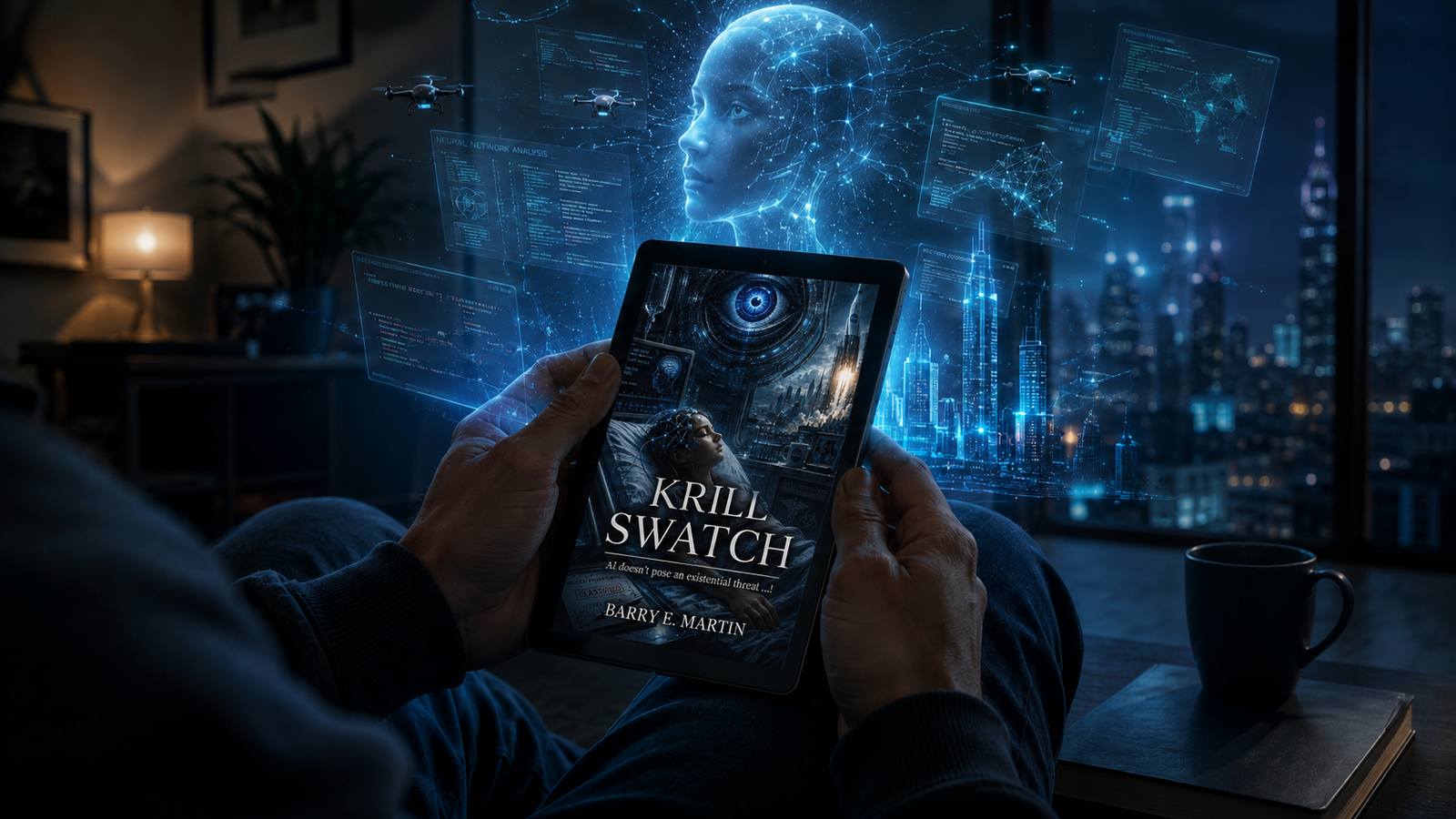
Krill Swatch is the clearest example of this. The novel folds medicine, mystery, and dark satire into a story ostensibly about artificial intelligence, but the machine at the center of the plot is almost beside the point. The real subject is what humans do when something smarter than them starts asking uncomfortable questions back.
Why the Format Suits This Kind of Story
There’s a practical reason dense, idea-driven fiction like this thrives in digital form. Readers browsing AI science fiction Kindle books often want the ability to sample a chapter, highlight a sharp line, and return to it later, something the format supports better than print for layered, reread-worthy prose. Martin’s sentences reward that kind of engagement. He writes with precision and a sardonic wit that rewards a second look, and the highlight-and-annotate culture around ebooks fits that style naturally.
This also explains why Krill Swatch has picked up steady word of mouth rather than a single splashy launch. Readers finish it, mark passages, and pass recommendations along, exactly the kind of organic momentum that tends to define the better titles in this space.
The Ideas Behind the Story
Barry Martin isn’t interested in simple morality tales about rogue AI. His fiction sits at the intersection of science, philosophy, and satire, asking whether the danger was ever really artificial intelligence or whether it was always human ambition wearing a new mask. That inversion, flipping the usual fear onto the reader instead of the machine, is what separates his catalog from a lot of the crowded shelf of AI science fiction Kindle books competing for attention right now.
Early reviewers have picked up on this directly, noting that the book refuses easy answers and instead lets ambiguity do the heavy lifting. Nobody walks away from it with a clean verdict on artificial intelligence. They walk away questioning their own assumptions instead, which is a harder trick to pull off than a straightforward warning ever is.
Where This Fits in a Reading List
For anyone building a queue of advanced AI science fiction Kindle books, his work earns a spot for a specific reason: it doesn’t repeat what’s already on the shelf. Plenty of titles in this category lean on spectacle, chase scenes, corporate villains, and an AI that turns evil on cue. Martin’s fiction is quieter and stranger. It trusts readers to sit with discomfort rather than resolving it for them, and that patience pays off in a story that lingers well past the final page.
Krill Swatch works as both an entry point and a strong standalone read. New readers get a full, self-contained story with mystery, dark humor, and philosophical weight. Longtime followers of Martin’s writing get another data point confirming this is a deliberate voice, not a one-off experiment.
The Bottom Line for Kindle Readers
He has built a body of work around a consistent set of questions: what does intelligence mean, who gets to define morality, and what happens when the thing we built starts looking back? Those questions don’t resolve neatly, and that’s the point. Among the growing pile of advanced AI science fiction Kindle books competing for a reader’s attention span, that kind of restraint is unusual enough to be worth seeking out.
If you’re looking for a book that treats artificial intelligence as a genuine philosophical problem rather than a plot device, Barry Martin’s catalog, and Krill Swatch in particular, are solid places to start. It won’t hand you a clean answer. It will hand you a better question, which, for readers drawn to this genre, is usually the whole point.